Boilerplate
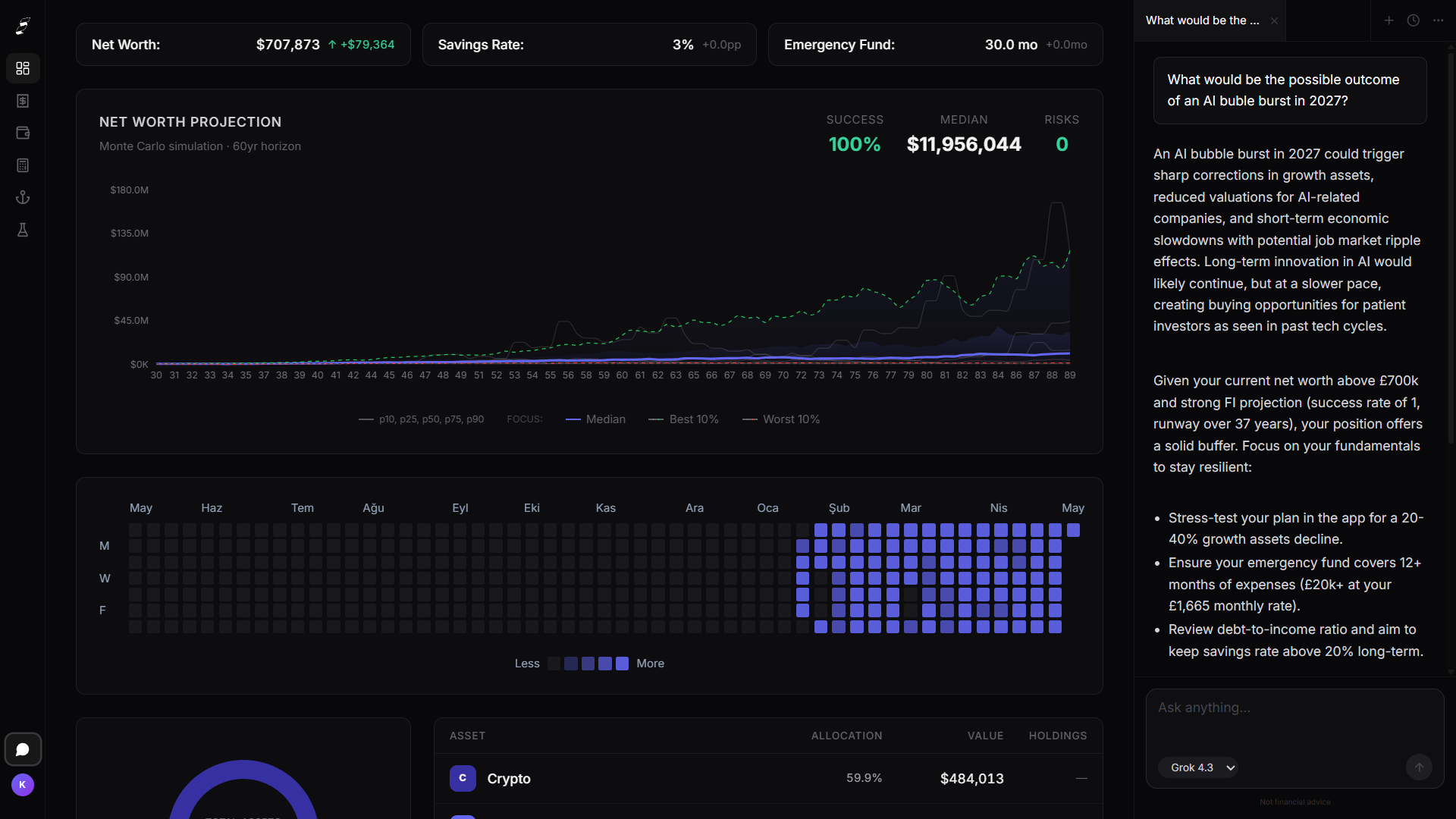
One line. Killion is financial planning software that connects your real holdings read-only and simulates decades of outcomes.
Short. Killion Labs builds retirement planning software for people who want to test a plan rather than be told a number. It links brokerage and crypto accounts read-only, runs a 1,000-path regime-switching Monte Carlo simulation, backtests plans against real market history to 1928, and models five named withdrawal strategies. It charges a flat subscription and takes no percentage of assets. Killion is software and is not a registered investment adviser.
Positioning. Most retirement tools produce a single confident number. Killion produces a distribution, states its method, and makes its runs reproducible.
Product facts
- Company: Killion Labs Ltd, registered in England and Wales, company number 16905669.
- Founder: Berkay Kolay, Founder, Killion Labs.
- Product launched: 2026. Public changelog at killionlabs.com/updates/changelog.
- Pricing: Pro $14/month or $132/year; Max $24/month or $228/year. No asset-based fees, commissions or kickbacks. 14-day refund window.
- Simulation: five-regime Markov switching model, Cholesky-correlated asset shocks, seeded and reproducible runs.
- Account linking: read-only through SnapTrade. No trading, transfer or withdrawal capability.
- Not modelled: taxes, Roth conversions, RMDs, annuities. Stated openly rather than implied.
- Try before you pay: the first plan includes a 5-day free trial of the full product.
Research available for citation
All of it is original simulation work with the method stated, and all of it is free to cite with a link. If you want the underlying figures for a chart, ask and we will send them.
- Vanguard dynamic spending vs the 4% rule: what the spending actually looks like — Vanguard dynamic spending vs the 4% rule on 5,000 paired retirements: +$17,834 lifetime spending in the median world, -$198,351 in the worst tenth. Q1-Q4 run.
- Monte Carlo retirement planning: what 1,000 lifetimes show that one projection hides — Monte Carlo retirement planning on one frozen retiree: real p50 $1.08M, p10 $0, p90 $5.69M at year 30, 10.4% ruin, versus a 7% deterministic path. 1,000 paths, seed 20260622.
- Why 90% chance of success is the right goal and 100% is a trap — 90% chance of success vs 100%: rigid 3.95% hits 90% on 1,000 paths. 2% still only 99.4%. 100% is not on the grid.
- Probability of success vs projected balance — Probability of success vs projected balance on 1,000 shared paths: 2% prints 99.4% and $1.89M median; 6% prints 63.0% and $308k.
- Why the 4% rule is riskier at 40 than at 65 — 4% rule riskier at 40 than 65: rigid 4% success 78.7% over 50 years vs 93.5% over 25 years. 1,000 paths, seed 20260622.
- The real math behind Coast FIRE — Coast FIRE math: stop saving at 45 and 32.5% of 1,000 paths still hold $1.5M at 65, vs 56% if contributions continue. Seed 20260622.
- Lump sum vs dollar-cost averaging: which the math favors — Lump sum vs DCA: lump wins 56.3% of 1,000 paths and 62.9% of 97 independent 12-month tape windows. Pre-tax, not advice.
- Why your portfolio's average return overstates what you'll get — Average return overstates compound: 5.01% arithmetic vs 3.27% geometric on 1,000 no-spend lives. $4.33M vs $2.62M median.
- Is 100% stocks brilliant or reckless? Quantified — 100% stocks quantified: 83.6% success and $1.11M median vs 60/40 at 93.9% and $945k. Rigid 4%, 1,000 paths. Not a historical claim.
- What History Did to Every Leverage Multiple from 1.00× to 3.00× — Long-term stock market leverage: 201 multiples from 1.00× to 3.00× on the 1928–2025 tape. Median, left tail and the long path peak at different L.
- Safe Withdrawal Rates by Retirement Age: 30 to 50 Year Horizons — Safe withdrawal rates by retirement age: rigid 4% and Guyton-Klinger on 30- to 50-year horizons, 200 seeded paths, seed 20260814. CSV included.
- How Many Monte Carlo Simulations Are Enough? — For most retirement plans, 1,000 simulations is enough: an 85% success rate lands within about 2 points, 83% to 87%. At 100 paths it is ±7.
- Monte Carlo vs Historical Backtesting in Retirement Plans — Monte Carlo vs historical backtesting: overlapping 40-year tapes are not a probability. Simulation is assumptive and reproducible. Use both.
- Does Monte Carlo Overstate Retirement Success? — Does Monte Carlo overstate retirement success? Independent draws miss clustered crashes. Ignoring fees and floors will print a kind number. What we do instead.
- Is the 4% Rule Still Safe? We Ran 5,000 Simulated Retirements — Is the 4% rule still safe? Flexible 4% lasted in 100% of 5,000 simulations; rigid 4% failed 1.1%. Full safe withdrawal rate trade-off table.
- What a 1% Investment Fee Really Costs Over 40 Years — What a 1% fee costs over 40 years: we simulated 5,000 lifetimes at 0%, 0.5%, and 1% expense-ratio drag. The dollar gap is larger than the percentage sounds.
- Sequence of Returns Risk: What If the Market Crashes the Year You Retire? — Sequence of returns risk explained: the same 40% crash dropped success from 86% to 71% at retirement age 65, but only to 81% at age 48. 5,000 simulations.
- Which Investing Strategy Wins? Six Strategies Benchmarked on the Same Markets — Which investing strategy wins? We benchmarked buy & hold, rebalance, glide path, guardrails, optimizer, and panic selling across 5,000 identical market lifetimes.
- Monte Carlo Simulation in Personal Finance: Why Projections Fall Short — Monte Carlo simulation in personal finance: a $4.3M projection landed at the 71st percentile; the median was $2.9M across 5,000 regime-aware lifetimes.
- Timing the Market vs Staying Invested: 40 Years of S&P 500 Evidence — Miss 10 best months: $744K becomes $264K on the same S&P 500 path since 1985. Why staying invested beats timing the market.
Logos and assets



Please use "Killion" for the product and "Killion Labs Ltd" for the company. Do not alter the marks or place them on backgrounds that reduce contrast.
Contact
Media enquiries go through the contact form and reach a founder directly. We can usually turn around a comment, a data request or a review account the same week.