At a glance
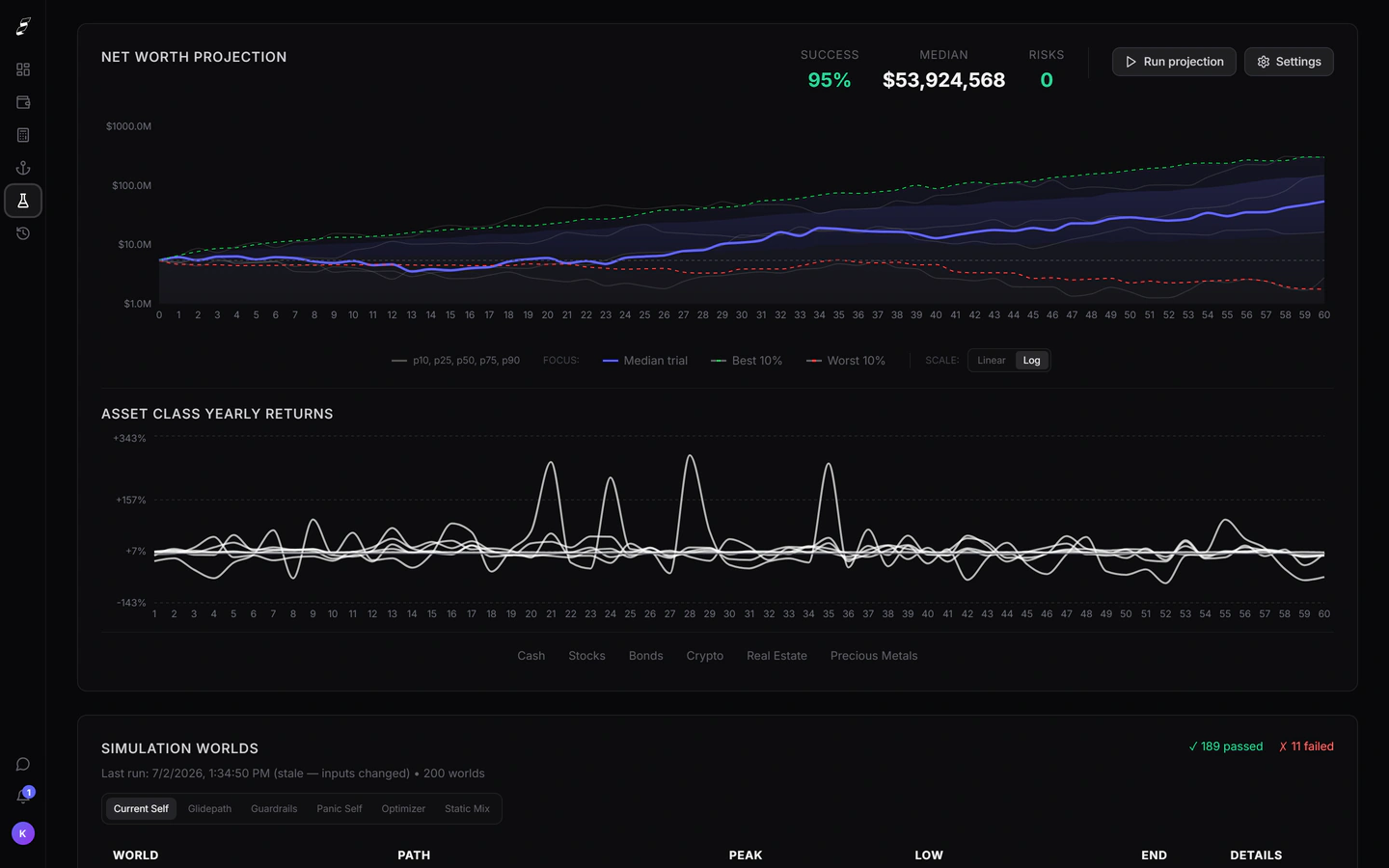


Killion is planning and simulation software with read-only account linking. Kubera is described below in its own terms. Where a figure is quoted it comes from the vendor's published pricing and was checked on the date shown.
| Killion | Kubera | |
|---|---|---|
| Individual price | $14/mo, or $11/mo billed annually ($132/yr). Max tier $24/mo or $19/mo annually. | Essentials $249/yr. Black tier $2,499/yr for complex structures. 14-day trial. |
| Free entry point | Live no-signup Monte Carlo demo on a fictional household, plus a 5-day free trial of the full product. Card required for the trial; no charge until it ends. | 14-day trial; no free tier. |
| Asset coverage | Linked brokerages and crypto exchanges, plus manually added cash, assets and liabilities. | Very broad, including real estate, private holdings, vehicles and collectibles. |
| Account linking | Read-only brokerage and crypto linking via SnapTrade. Cash and bank balances are entered manually while automatic bank linking moves to a new provider. | Wide connector coverage across many countries and institutions. |
| Long-horizon simulation | 1,000-path regime-switching Monte Carlo with fixed seeds, so a run reproduces. | Forward projection features exist; Monte Carlo is not the core. |
| Historical backtesting | Historical backtesting against real market data going back to 1928. | Not offered. |
| Withdrawal rules | Nine named rules: fixed real dollar, fixed percentage, Guyton-Klinger, Vanguard dynamic, endowment smoothing, VPW, CAPE-based, risk-based guardrails, and Merton. | Not a decumulation tool. |
Kubera details checked on against the Kubera pricing page. Vendors change prices; verify before deciding.
Breadth against depth
Kubera’s value is that almost nothing is un-trackable: it will hold a flat in Lisbon, a slice of a private company and a car, and keep a single number current across all of it. If your balance sheet looks like that, no simulator will substitute for it.
Killion assumes most of what matters is liquid and linkable, and spends its complexity elsewhere — on modeling what those holdings do over four decades under thousands of market paths, and on what a withdrawal rule does to the odds of running out.
The price gap is real
At $249 a year, Kubera Essentials costs close to double Killion Pro at $132. That is defensible for the connector breadth if you need it, and hard to justify if your accounts are three brokerages and a bank.
Which one to choose
Choose Killion if
- Your wealth is mostly in liquid, linkable accounts and the open question is the trajectory.
- You want to test withdrawal policies and crash timing, not only see a balance.
- You want to spend a third of the price.
Choose Kubera if
- A meaningful share of your net worth is illiquid — property, private company stock, collectibles.
- You hold accounts across several countries and need wide connector coverage.
- Consolidated tracking, not projection, is the actual job.