At a glance
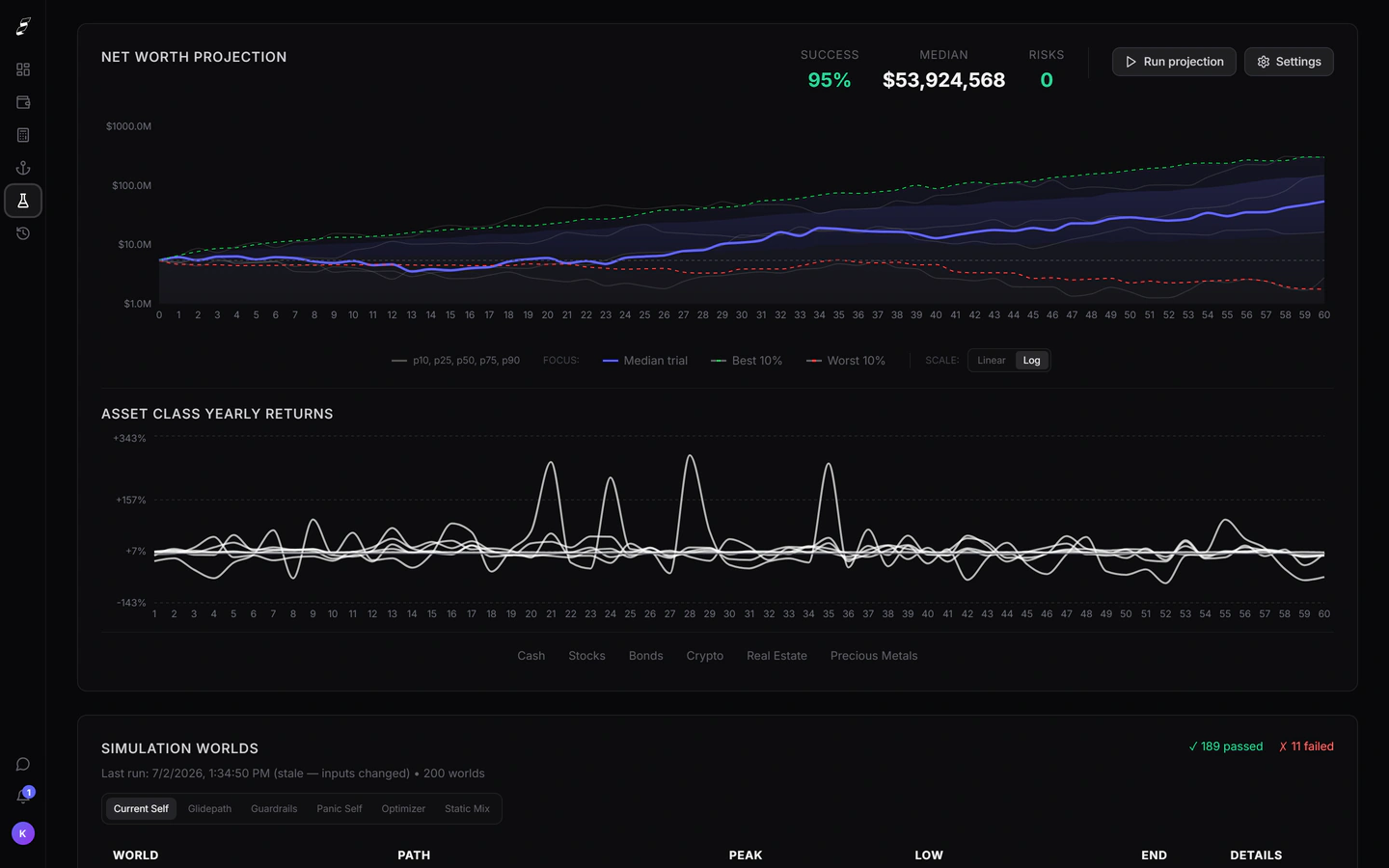


Killion is planning and simulation software with read-only account linking. Boldin is described below in its own terms. Where a figure is quoted it comes from the vendor's published pricing and was checked on the date shown.
| Killion | Boldin | |
|---|---|---|
| Individual price | $14/mo, or $11/mo billed annually ($132/yr). Max tier $24/mo or $19/mo annually. | Free tier available. PlannerPlus $144/yr for new subscribers ($12/mo billed annually); existing subscribers stay at $120/yr. |
| Free entry point | Live no-signup Monte Carlo demo on a fictional household, plus a 5-day free trial of the full product. Card required for the trial; no charge until it ends. | Free plan with a reduced feature set. |
| Account linking | Read-only brokerage and crypto linking via SnapTrade. Cash and bank balances are entered manually while automatic bank linking moves to a new provider. | Account linking for net worth and balances. |
| Tax modeling | Not modelled today. Killion projects pre-tax outcomes and states so; tax-aware withdrawal sequencing is not implemented. | Roth conversion modeling, tax-bracket and IRMAA-aware planning. This is the product’s center of gravity. |
| Simulation method | 1,000-path regime-switching Monte Carlo with fixed seeds, so a run reproduces. | Monte Carlo with optimistic/pessimistic assumption sets. |
| Historical backtesting | Historical backtesting against real market data going back to 1928. | Not the primary method. |
| Withdrawal rules | Nine named rules: fixed real dollar, fixed percentage, Guyton-Klinger, Vanguard dynamic, endowment smoothing, VPW, CAPE-based, risk-based guardrails, and Merton. | Withdrawal-order and spending strategies with tax awareness. |
| Human advice | None. Killion is software; it is not a registered investment adviser. | Paid sessions with financial advisers are available. |
Boldin details checked on against the Boldin pricing page. Vendors change prices; verify before deciding.
Where Boldin is genuinely ahead
Boldin models the tax side of decumulation properly: which account to draw from, what a Roth conversion in a low-income year does to lifetime tax, and where the IRMAA cliffs sit. For someone five years from retirement, those decisions are often worth more than a better return model.
Killion does not model taxes today. Projections are pre-tax, and the product says so rather than implying otherwise. If tax sequencing is the question you came with, Boldin answers it and Killion does not.
Where Killion is ahead
Killion’s engine is the product rather than a feature of it. Returns come from a regime-switching model in which bad years cluster, runs are seeded so results reproduce, and the same plan can be backtested against every starting year since 1928 rather than only sampled.
That matters most for the questions Monte Carlo is actually good at: how much sequence-of-returns risk you are carrying, how much a flexible spending rule buys you compared with a rigid one, and how wide the range of outcomes really is around the median you were quoted.
Killion also ships five named withdrawal rules — including Guyton-Klinger guardrails and Vanguard-style dynamic spending — and benchmarks them against each other on identical simulated markets.
They are not mutually exclusive
These two products answer different halves of the same problem, and plenty of people run both: Boldin for the tax and Social Security decisions, Killion for the simulation and the stress tests. At $132 and $144 a year that is a real cost, but it is a fraction of one year of a 1% assets-under-management fee on a $500,000 portfolio.
Which one to choose
Choose Killion if
- You want to stress-test the plan itself: what a crash in year one of retirement does, how a guardrail rule changes the ruin rate.
- You want every figure reproducible, with the engine documented rather than described.
- You are still accumulating and the tax question is years away.
- You want an AI assistant with your real holdings in context.
Choose Boldin if
- You are within a decade of retiring and Roth conversion sequencing is the live decision.
- You want IRMAA and tax-bracket thresholds modelled explicitly.
- You want the option to buy time with a human adviser inside the same product.
- You want a free tier to start on.